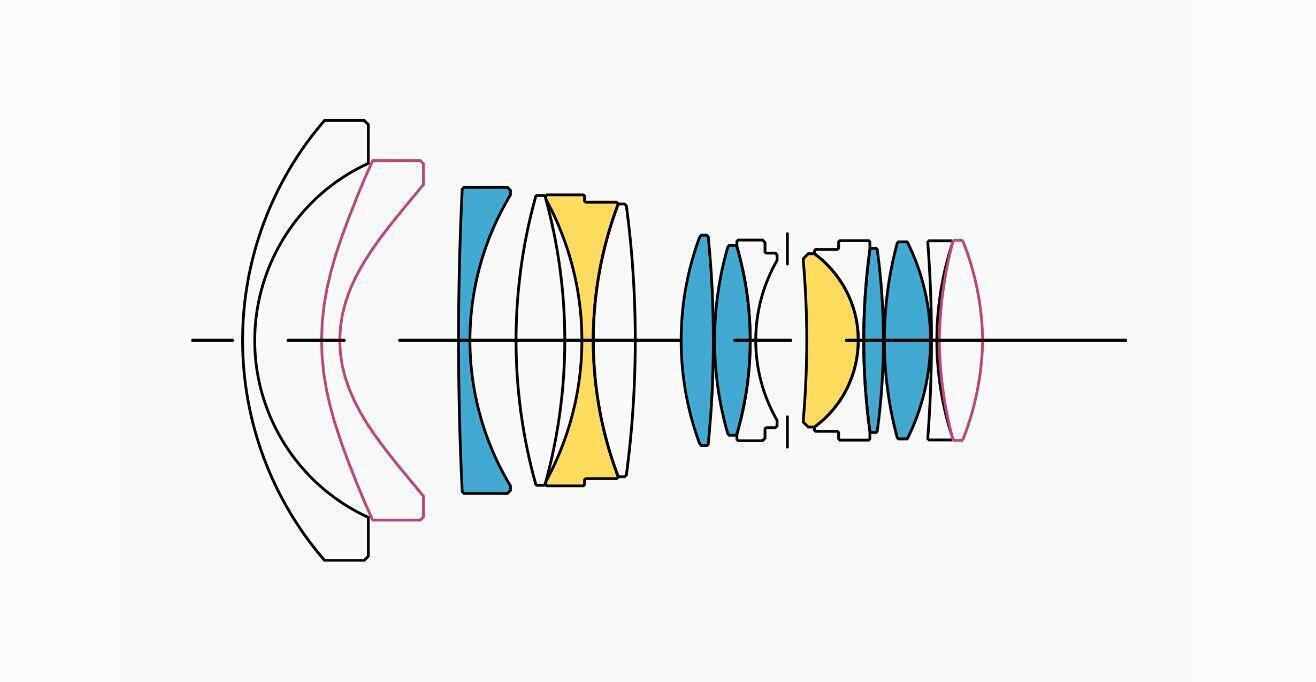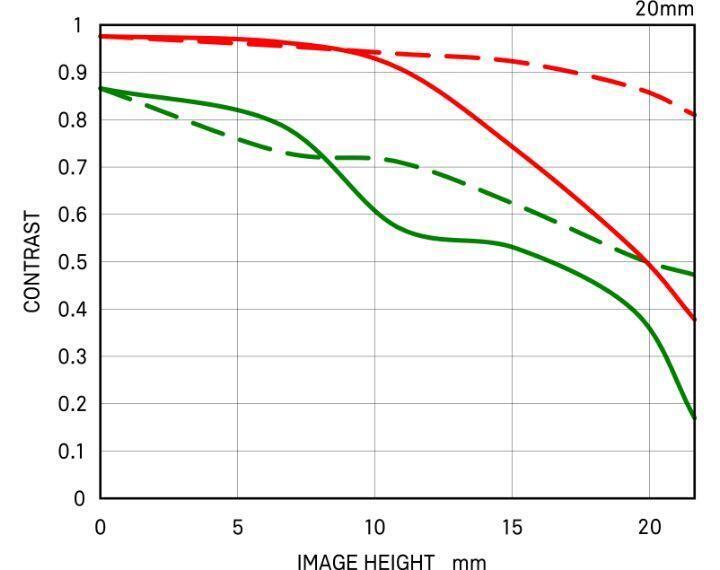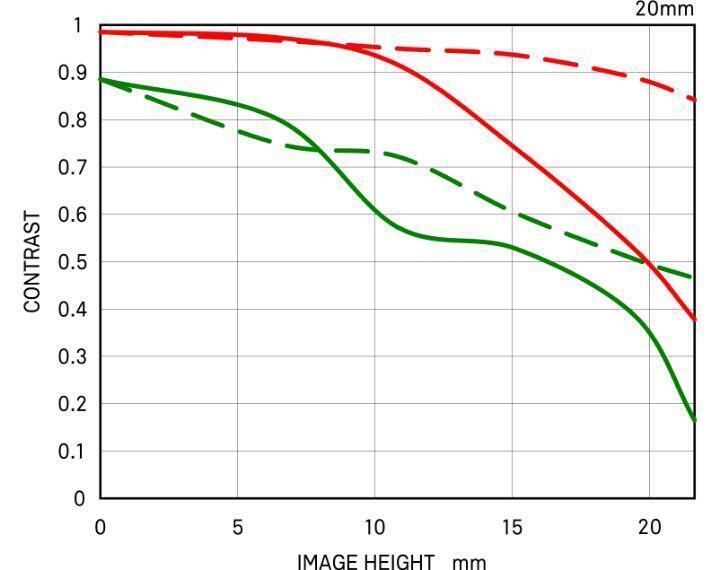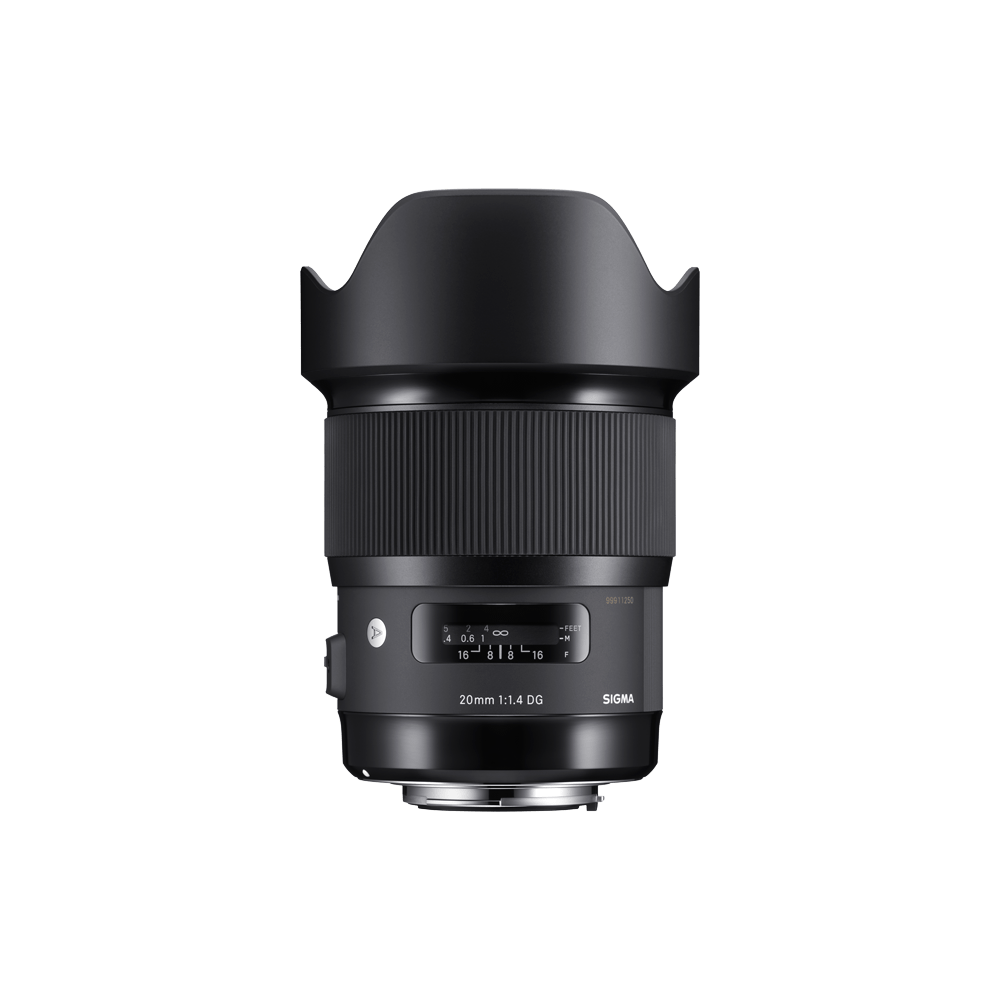
This lens minimizes chromatic aberrations, a common issue in large-aperture ultra-wide-angle lenses. It features two
(*)FLD (“F” Low Dispersion) glass and five SLD (Special Low Dispersion) glass elements to minimize transverse chromatic aberration, which is mainly visible around the edge of the image. The optimized lens power distribution helps minimize axial chromatic aberration. As a result, this lens delivers high image quality in every situation without color smearing, and its rendering performance is consistently sharp with high contrast.
(*)FLD ("F" Low Dispersion) glass
FLD glass is ultra-low-dispersion glass that offers performance of the highest level. Highly transparent, its refractive index and dispersion are extremely low as compared to conventional types of glass. It offers characteristics very similar to those of fluorite, which is valued for its anomalous dispersion. These characteristics minimize residual chromatic aberration (secondary spectrum), which cannot be corrected by ordinary optical glass, while helping to produce sharp, high-contrast images.
Top-level performance for the ultra-high-megapixel era
At the dawn of the film camera, there was very little high-sensitivity film, and bright lenses that worked well in low-light conditions came to be known as “high-speed lenses.” These lenses are ideal for shooting indoors, in the evening, under cloudy skies, or in any low-light situation. Since the Sigma 20mm F1.4 DG HSM | Art provides the benefits of an ultra-wide angle lens with minimal distortion, it is ideal for photographing landscapes, starry skies, and architecture. In addition to capturing wide-angle shots with the whole scene in focus, the photographer can leverage wide-open aperture to take snapshots with the subject in focus and the background blurred with an attractive bokeh effect. Designed for ultra-high-megapixel digital cameras, this high-performance lens delivers outstanding resolution and high-clarity image quality even at wide-open aperture.
A refined, integrated design made with the photographer in mind
In our new product lines, the lens caps and AF/MF switches are newly designed to improve usability. To ensure precise operation, internal parts feature generous use of metal and (*)TSC (Thermally Stable Composite), which is highly compatible with metal parts. The lens barrel is engraved with the year of release for instant access to this information.
(*)TSC (Thermally Stable Composite)
TSC (Thermally Stable Composite) is a type of polycarbonate with a thermal expansion rate similar to that of aluminum. It has high affinity to metal parts which contributes to high quality product manufacturing.
The Hyper Sonic Motor (HSM) ensures silent, high-speed autofocusing, while the optimized AF algorithm helps realize even smoother AF performance. At any time during AF, users may access MF simply by rotating the focus ring. This feature makes faster focus adjustment possible, since there is no need to use the AF/MF focus mode switch. Also, the optional Sigma USB DOCK allows the user to set the lens to conventional full-time manual focus override.
Note: The operation of full-time MF may vary based on mount type.