31.0°
21.4°
20.7°
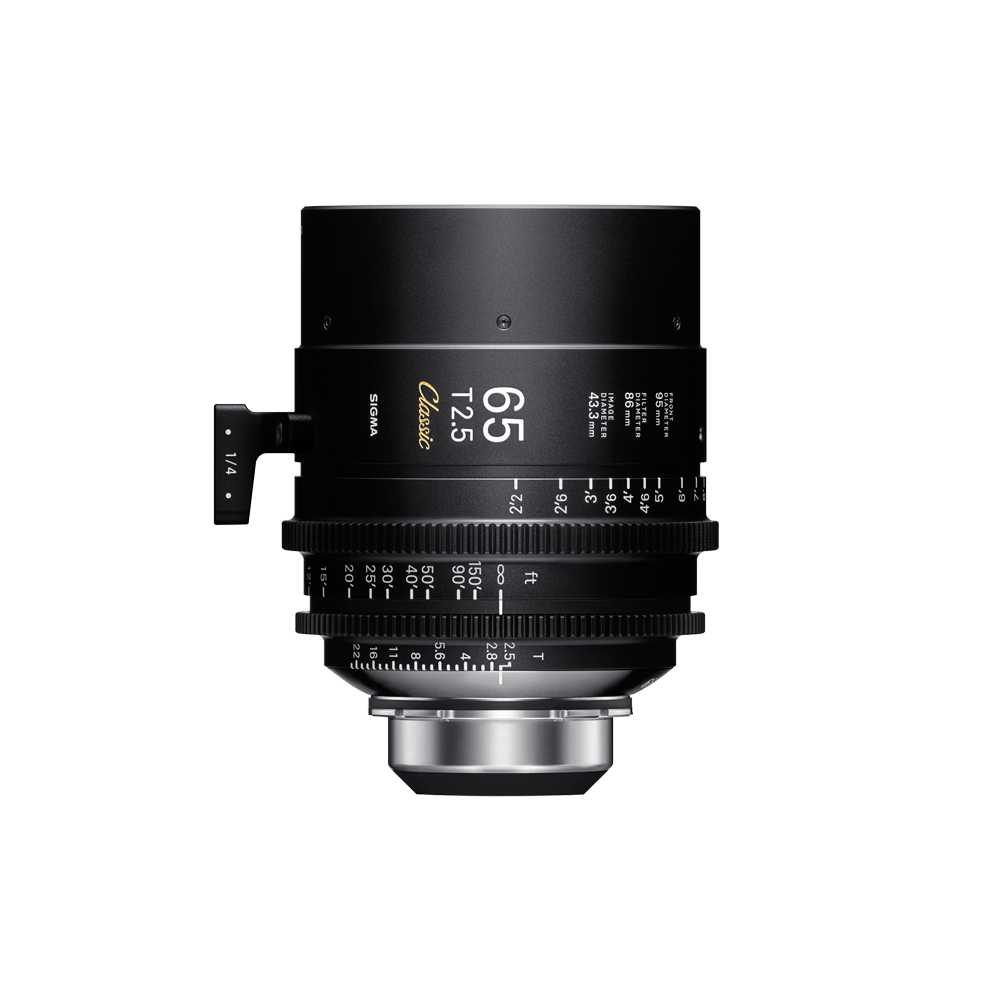
The filter size is standardized at Φ82mm or Φ86mm, allowing users to use the same size of ND filter on different lenses.
*Some models are not compatible with filters
・Φ82mm:
24mm T2.5 FF~50mm T2.5 FF, 135mm T3.2 FF
・Φ86mm:
65mm T2.5 FF, 85mm T2.5 FF:M 86 x 1.0 mm
・Not compatible:
14mm T3.2 FF, 20mm T2.5 FF, 105mm T2.5 FF
The positions of the gears in each ring are standardized, eliminating the need to adjust the follow focus, motor unit, or accessories even when the lens changes.
Each lens has a 0.8M gear pitch, which is the standard for cine lenses, ensuring compatibility with existing accessories.
The stopper of each ring incorporates a damper made of a special resin, resulting in silent operation. While offering a satisfying lock feel, this feature eliminates any metallic sounds, allowing the user to shoot with confidence in a quiet area.
At 180°, the rotational angle of the focus ring is more than double that of a still camera lens, making possible extremely high-precision focusing. Sigma has also optimized the cam for cine lenses for even easier long distance focusing.
The stopper of each ring incorporates a damper made of a special resin, resulting in silent operation. While offering a satisfying lock feel, this feature eliminates any metallic sounds, allowing the user to shoot with confidence in a quiet area.
At 180°, the rotational angle of the focus ring is more than double that of a still camera lens, making possible extremely high-precision focusing. Sigma has also optimized the cam for cine lenses for even easier long distance focusing.
At 160°, the rotational angle of the zoom ring is more than double that of a still camera lens, making possible extremely high-precision zooming.
Featuring manual control capability, the iris ring offers smooth control without clicks. The T-stop display, which is standard in cine lenses, contributes to high-precision exposures. Just like a high-end cine lens, the rotational angle of the iris ring is 60°.
The linear iris ring gives users the same rotational angle per T-stop for direct, intuitive control.
Based on user needs, a focus ring with either feet or meter graduations may be selected. For a small charge, Sigma can also convert the ring from one type to the other after purchase.
Coming as a standard accessory with all lenses in the lineup, the lens support foot helps minimize load on the camera body while enhancing mount stability. The height of the seating surface is designed for compatibility with other accessories. Even though the lens is compact, its robust design offers two different screw holes for this accessory to increase user options.
Cine-style front lens cap
FF High Speed Prime Line has been offering the highest resolving power in its class, that is compatible with 8K shooting with large format sensors, while achieving outstanding compact design. Based on this product line, the FF Classic Prime Line incorporates more non-coated optical elements to achieve unrivaled expression. It retains the high resolution capability that Sigma CINE LENS is well known for, and offers a unique combination of low contrast and artistic flare/ghost in the image. As with all other lenses from the FF High Speed Prime Line, it creates beautiful bokeh effects to improve creativity.
FF Classic Prime Line has implemented newly developed coatings on the glass elements and offers consistent T value across the lineup (14mm and 135mm at T3.2 and the rest of the lenses at T2.5). This will greatly contribute to the effective workflow in postproduction. Furthermore, it is compatible with the communication protocol of Cooke “/i Technology”, thus an ideal tool for shooting and editing with the latest technology, such as VFX. A special coating is implemented on the front and rear elements so that the lens durability is ensured as with all other cine lenses from Sigma.
“Classic Art Prime” is a new solution from Sigma that is required for the most advanced technology for classical expression. The “look” that FF Classic Prime Line can offer will enable cinematographers to explore new possibilities in movie creation.
Sigma always pursues “the best materials and technology” without compromise to achieve the highest quality. The Classic Art Prime series is no exception, and the policy is even alive in the logo. To identify the lens in the shooting scene using a wide variety of lenses, and to provide the texture and quality suitable for professional tools, and the durability to support the harsh environment of cinema lenses. Aizu-nuri (Aizu lacquering) was the solution for the “Classic” logo. Fortunately the best technique was at our production site, Aizu.